 teeofftidyOriginal audioView profile
teeofftidy Six hours of correction. Ten years of protection. 🤝
Western Sydney runs hotter and drier than the coast, and both of those numbers work against your paint. Here is what the Bureau of Meteorology record for our corner of Sydney actually says, and what it means for how often your car needs attention.
The short version
Anyone who has driven from the city to Blacktown on a January afternoon knows the temperature climbs as you go west. The Bureau of Meteorology puts numbers on it. At Richmond RAAF, station 067105, a short drive from Colebee, the mean maximum for January is 30.4 degrees across 33 years of record. At Sydney Observatory Hill, station 066062, the January mean maximum is 26.0 degrees, measured over 162 years.
That is a gap of more than 4 degrees between the city and our side of Sydney, on an average day. Not a heatwave, not a record, just an ordinary summer afternoon in Marsden Park, The Ponds or Colebee.
A car parked in the open does not experience the air temperature. It experiences the sun directly. Panels are sheet metal over an oven of a cabin, and they sit in that sun for the full working day. The air number is just the starting point, and out here the starting point is already 4 degrees worse than the coast.
Modern paint is a layered system. The colour you see is under a transparent layer called the clear coat, and the clear coat is what actually faces the weather. Gloss, depth, protection from the sun: all of it is riding on that top layer staying healthy.
Heat makes everything that attacks a clear coat work faster. Water dries quicker and leaves its minerals behind as spotting. Contaminants soften and bond harder. The surface itself expands and contracts with every hot day and cool night, which is exactly the cycle our climate delivers all summer.
None of this ruins a car in a week. It is slow, which is the problem. Oxidised, faded, swirl covered paint arrives over a few years of parking outside, and by the time you can see it from the kerb, a wash will not bring it back. That is when correction becomes the only road home, and machine paint correction is a full day of work rather than an hour.
Dark colours absorb more of the sun's energy than light ones, so a black or deep green car runs hotter on the same afternoon. Dark paint also shows every swirl mark and water spot more clearly. If you own a dark car in Western Sydney, you are playing the game on a harder setting, and routine is the thing that saves you.

The rainfall numbers surprise people more than the temperature. Richmond's mean annual rainfall is 761.4 mm. Observatory Hill records 1,213.4 mm. The city gets roughly half as much rain again as we do out here, year after year.
Less rain sounds like good news for a clean car, and in one narrow way it is: fewer muddy downpours. But rain is also the only rinse most cars ever get between washes. A drier suburb means dust, pollen and road film sit on the paint for longer, drying harder in the heat, until something physical removes them.
The worst version of that removal is a dry wipe. Dragging a sleeve, a trolley, or a dry cloth across a dusty panel grinds the dust into the clear coat and leaves fine scratches. Most of the swirl marks we correct were put there by cleaning, not by neglect.
A fortnightly or monthly exterior maintenance wash keeps the surface load light, so nothing gets the time or the heat it needs to bond permanently. Stretch that gap to a season and the same wash has to fight embedded contamination, and the risk of marring goes up with every pass of the mitt. Little and often beats heroic and rare.
Winter flips the problem without solving it. The July mean minimum at Richmond is 3.8 degrees, against 8.1 at Observatory Hill. Clear, still, cold nights are standard here from June to August, and a car outside on a night like that wakes up soaked in dew.
Dew is not a rinse. It wets the dust already sitting on the car, then dries slowly through the morning, leaving spotting and streaks. Day after day, that cycle builds a film that dulls the finish, and on glass it is the smeary haze you fight every morning commute down Richmond Road through Blacktown.
Winter is also when people wash least, which makes the maths worse. The car carries more grime for longer exactly when it is wet every single morning.
Bird droppings, tree sap and bug splatter are the sharp end of all of this. They are not just dirt sitting on the surface. They interact with the clear coat, and warmth speeds that up.
You do not have to take our word for the urgency. Ceramic Pro, one of the biggest coating manufacturers in the world, tells owners of its coated cars to avoid letting bird droppings, bug splatter, sap or pollen sit for more than a few days, and to avoid parking under trees because sap and falling debris can etch and scratch even a coated surface. That advice is for cars wearing a protective coating. On bare clear coat, the window is tighter still.
The practical rule is simple. Droppings and sap come off at the next opportunity, not at the next scheduled wash. Keep a dedicated microfibre cloth and a proper detail spray in the glovebox, soften the spot, lift it gently, and never scrub it dry.
Put the numbers together and a sensible Western Sydney routine falls out of them. Regular exterior washes through summer, because heat and dust are doing their work every day the car sits outside. No long winter gaps, because dew keeps wetting whatever is on the panels. Spot removal of droppings and sap within days, all year round.
The inside matters too. Cabin heat is hard on trim and upholstery, and the same dust that settles on the bonnet settles on the dash. An interior and exterior maintenance wash covers both sides in about 90 minutes, and a few times a year a deeper deluxe detail resets the whole car in around 3 hours.
Tee Off Tidy exists because a wash routine is easier to keep when it costs you no time. We are based at Stonecutters Ridge Golf Club in Colebee. Drop the car when you arrive, play your round, and drive home in a clean car. The exterior wash takes about an hour, which is comfortably inside the front nine. You do not need to be a golfer either, everyone is welcome to book a wash.
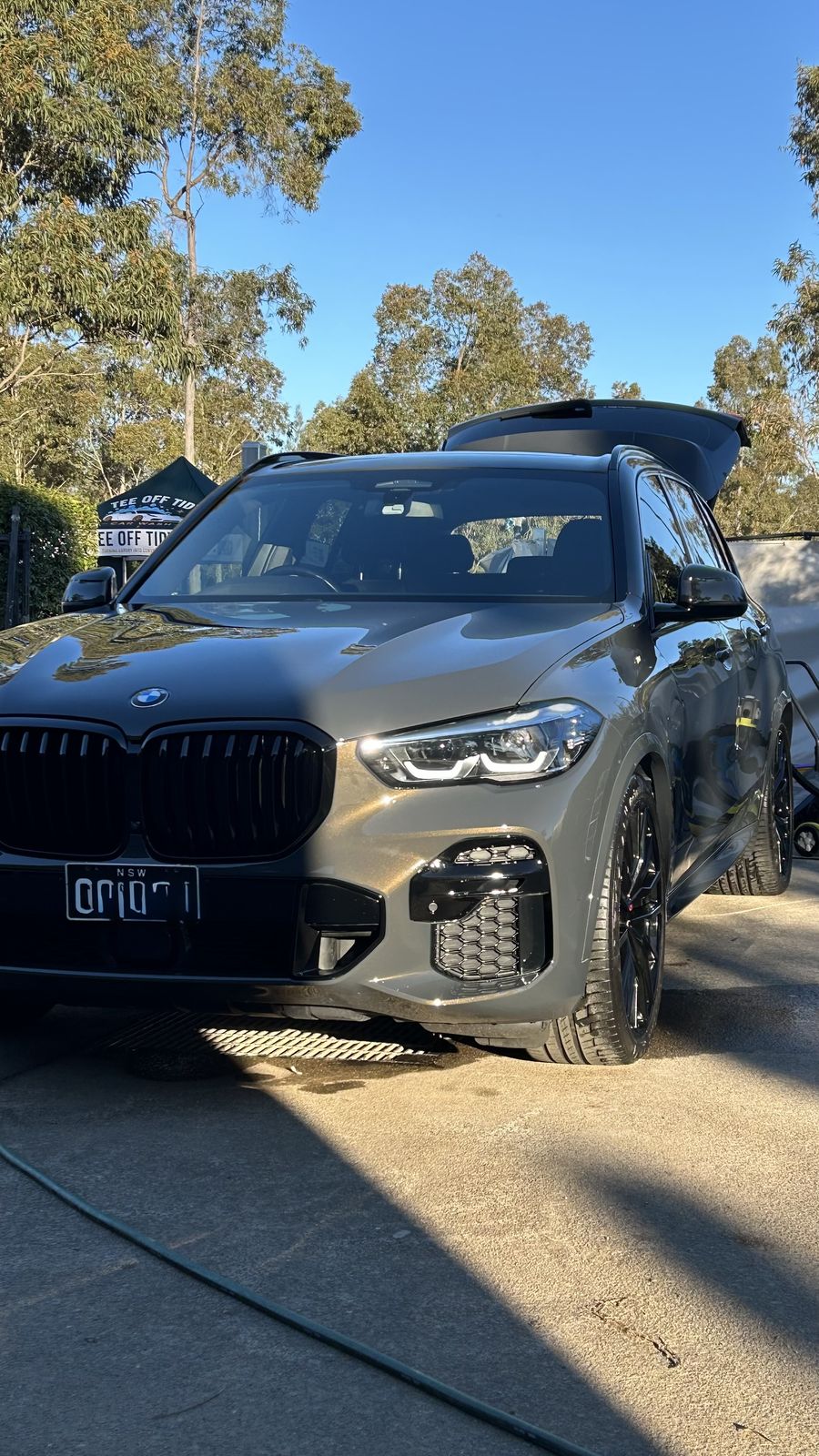
Washing manages the climate. Protection changes the terms. A ceramic coating is a hard transparent layer bonded over the clear coat, so the sun, the dust, the dew and the droppings deal with a sacrificial surface first. Water beads rather than sheeting into spots, and dirt releases with less effort at every wash.
If the paint has already picked up a few summers of swirl and dullness, coating over the top locks that condition in. The right order is machine correction first, then the coating, which is exactly what our combined paint correction and ceramic coating service does in a single full day at the club.
A coating is not a force field, and the manufacturers say so themselves. It still needs washing, and it has its own aftercare rules. What it buys you, in a climate like ours, is a margin for error that bare paint does not have.
None of this needs instruments. The climate leaves evidence you can find in two minutes on your own driveway, and the back of your hand is the first tool. After the next wash, run it lightly over the middle of the bonnet and the top of the rear bumper. Clean, healthy clear coat feels like glass. A gritty or slightly rough texture under your fingers is contamination that has bonded to the surface, which is exactly what heat and long dry spells produce, and no amount of ordinary shampoo will shift it once it has set in.
Water tells you the second half of the story. Watch what the hose does on a flat panel. Water that gathers into beads and rolls away is sitting on some form of protection. Water that lies flat and sheets into patches means the surface is bare, and bare clear coat is taking the full force of everything this article describes. A car that has never been waxed, sealed or coated will almost always fail this test, and every month outside shortens the life of whatever protection was once there.
Finally, look at the glass on a cold morning. A smeary haze that comes back a day after you clean it, or wipers that chatter and streak, is the dew and dust film doing its rounds. The windscreen collects the same deposits as the paint. It is just the only panel you look through instead of at, so it is where the problem shows itself first.
If the car lives outside anywhere from Schofields to Rouse Hill, start with a regular exterior wash and honest spot removal, and the climate loses most of its leverage. If you want the finish protected properly before another summer gets at it, ask us about correction and coating. Get in touch for a free quote, or drop in at Stonecutters Ridge Golf Club between 8am and 4pm and we will take a look at the car together.
Our process is simple and only contains a few simple steps
Book your car in for a wash or detail while you play at Stonecutters Ridge Golf Club. Quotes are free.
Straight from the Instagram feed
teeofftidyOriginal audioView profileteeofftidy Six hours of correction. Ten years of protection. 🤝
teeofftidyOriginal audioView profileteeofftidy You play. We detail. ⛳️🚗
teeofftidyOriginal audioView profileteeofftidy POV: What I see vs what my clients see: 👨🔧💦🚗😂
teeofftidyOriginal audioView profileteeofftidy You might’ve seen a few of these… but definitely not all of them 👀
teeofftidyOriginal audioView profileteeofftidy POV: You’ve been trusted with a Lamborghini Urus. 🐂🔥
teeofftidyOriginal audioView profileteeofftidy Water doesn’t stand a chance. 💦🏌️♂️
teeofftidyOriginal audioView profileteeofftidy Small car. Big personality. 🏁✨
teeofftidyOriginal audioView profileteeofftidy We love cars. We love golf. ⛳️🚘
teeofftidyOriginal audioView profileteeofftidy Let’s take a break from the detailing bay… ⛳🌅
teeofftidyOriginal audioView profileteeofftidy Imagine finishing your round of golf… ⛳
teeofftidyOriginal audioView profileteeofftidy Clean isn’t a service. It’s a standard.
teeofftidyOriginal audioView profileteeofftidy It’s all in the transformation. ✨